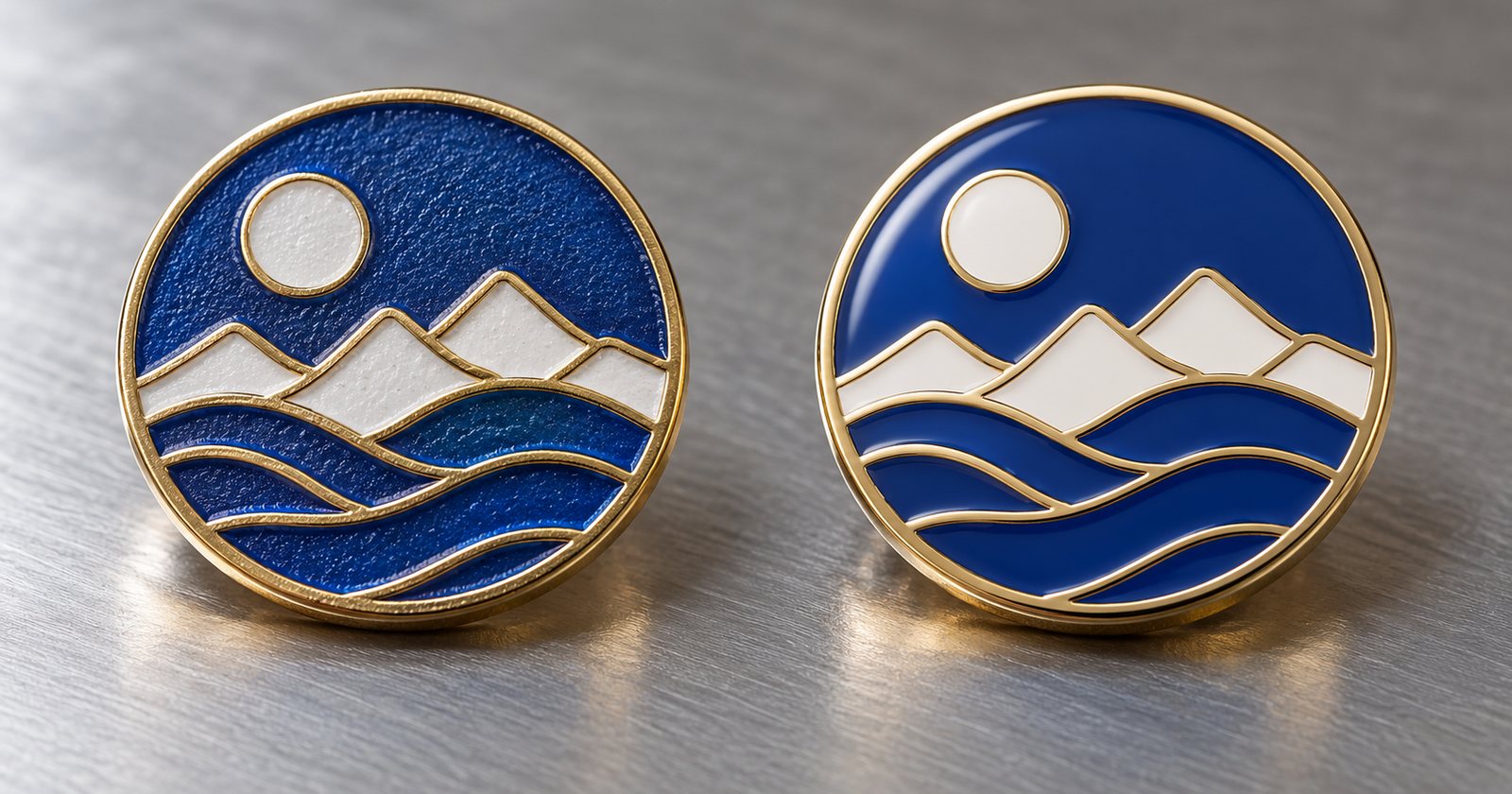
Soft enamel and hard enamel are the two most common ways to add colour to a custom pin, medal or challenge coin. Both start the same way: a steel die is cut from your artwork, the metal is struck or cast, and raised metal lines separate one colour from the next. The difference is what happens after the colour goes in.
This guide explains how each one is made, how they look and feel, and how to choose.
The short answer
- Soft enamel: colour sits below the raised metal lines, so you can feel the outline with your fingertip. It costs less and suits event medals, giveaway pins and keychains.
- Hard enamel: colour is filled level with the metal and polished smooth. It looks and feels like jewellery and suits awards, uniform badges and pins people will keep for years.
If you are still unsure after reading, ask us for a sample of each. Seeing them side by side settles the question quickly.
How soft enamel is made
After the piece is struck or die-cast and plated, workers fill each recessed area with liquid enamel colour by hand, one colour at a time, matched to the Pantone references on your artwork. The pieces are then cured in an oven. The enamel shrinks slightly as it cures, so it settles below the metal lines.
The result is a textured surface: shiny raised metal outlines with colour sitting in the hollows. On a medal hung from a ribbon, that texture catches the light and makes the design read well from a distance.
Soft enamel can also be finished with a clear epoxy dome, a thin layer of resin over the front. The dome makes the surface smooth and glossy and protects the colours, at a small extra cost. It gives a different look from hard enamel: a rounded, glassy surface rather than a flat polished one.
How hard enamel is made
Hard enamel uses the same recessed areas, but the colour is filled until it is level with, or slightly above, the metal lines. After curing, the face of each piece is ground and polished flat so the enamel and metal lines become one smooth surface. The plating is applied after polishing so the metal lines stay bright.
Because of the extra filling and polishing, hard enamel takes more labour per piece and costs more than soft enamel for the same design. In exchange, you get a very durable, scratch-resistant surface and a premium, jewellery-like finish.
Hard enamel is usually made on brass or copper, which polish cleanly. Read our guide to zinc alloy vs brass vs copper for more on how the base metal affects the result.
Side-by-side comparison
| Soft enamel | Hard enamel | |
|---|---|---|
| Surface | Textured, colour below metal lines | Smooth, colour level with metal |
| Look | Bold outlines, depth | Flat, polished, jewellery-like |
| Durability | Good; better with epoxy dome | Very good; resists scratches |
| Relative cost | Lower | Higher |
| Typical base metal | Zinc alloy, iron, brass | Brass, copper |
| Best for | Event medals, giveaway pins, keychains | Awards, uniform badges, collector pins |
When to choose soft enamel
Choose soft enamel when:
- you are ordering in large quantities and unit cost matters, such as finisher medals for a race or pins for a conference;
- the design has bold shapes and you want the metal outlines to stand out;
- you want 3D relief or cut-outs on a die-cast zinc alloy medal, where soft enamel is the natural partner;
- the pieces will be handed out once and worn on the day.
Soft enamel is the most common choice for custom medals for sports and community events.
When to choose hard enamel
Choose hard enamel when:
- the piece is an award, a long-service badge or a collector item that people will keep;
- it will be worn every day, on a uniform or a lanyard, and needs to resist wear;
- you want a smooth surface that feels premium in the hand;
- you are making enamel pins for retail, where buyers compare finish quality closely.
Design tips that apply to both
Every colour needs a metal line around it. Enamel colours cannot touch each other without a raised metal border, because the liquid would run together. When we redraw your artwork as production vector files, we add these lines. Very small details may need to be simplified.
Gradients and photos need printing. Enamel colours are solid. If your design depends on a colour fade, a photo or very fine detail, printing with an epoxy dome is the better method. See all crafts on our customization page.
Pantone matching has limits. We mix enamel to the Pantone references on your approved artwork. Enamel is a different material from printed ink or a screen, so neon and very pale shades can look slightly different. We point these out at the proof stage.
Check small text carefully. Thin letters can fill in or blur at small sizes, in both crafts. If your design has tiny text, ask us whether it will hold up at your chosen size.
How to make sure you get what you expect
Every order goes through two approval points before anything is made: first a colour design draft, then the vector artwork with Pantone references and plating notes. Nothing is cut until you approve the vector file. After that, we produce a pre-production sample so you can see and feel the actual finish before mass production. Our how it works page walks through each step.
If you cannot decide between soft and hard enamel, say so when you request a quote. We will price both options for your design so you can compare.