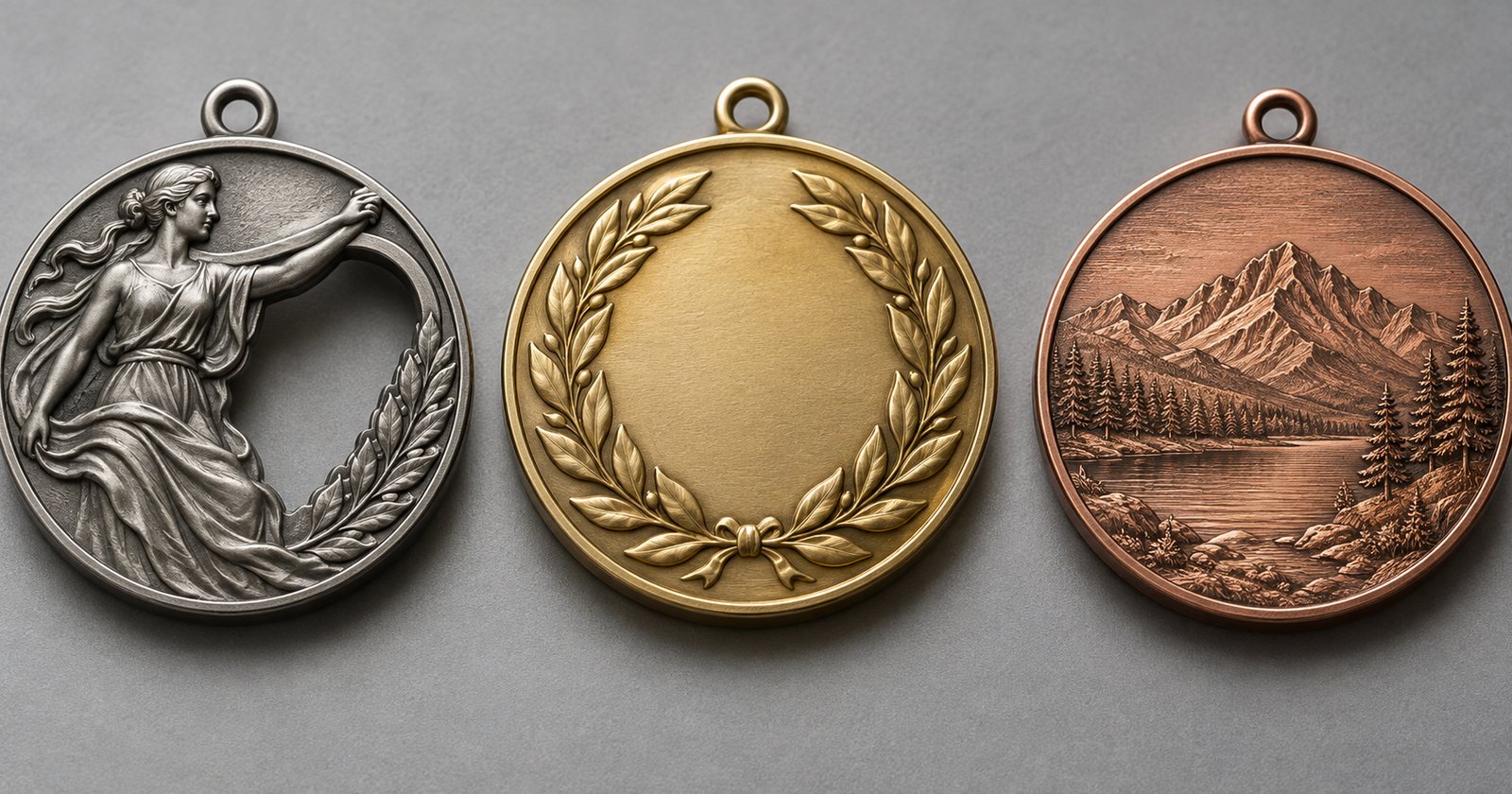
The base metal of a medal decides how it can be made, how much detail it holds, how heavy it feels and, to a large extent, what it costs. Once it is plated, a zinc alloy medal and a brass medal can both look gold, so the difference is not always obvious from a photo. It is obvious in the hand.
This guide compares the three metals we use most for medals and coins: zinc alloy, brass and copper. It also covers when iron, stainless steel or aluminium make more sense.
Quick comparison
| Zinc alloy | Brass | Copper | |
|---|---|---|---|
| How it is made | Die-cast in a mould | Die-struck from sheet | Die-struck from sheet |
| Shapes | 3D relief, cut-outs, complex outlines | Flat or low relief, clean outlines | Flat or low relief, very fine detail |
| Weight | Lighter for the same size | Heavier, solid feel | Heavier, solid feel |
| Best enamel | Soft enamel | Hard or soft enamel | Hard or soft enamel |
| Relative cost | Usually lowest for complex shapes | Higher | Higher |
| Typical use | Sports and event medals | Awards, police badges, premium pins | Commemorative medals and coins |
Zinc alloy: the flexible choice
Zinc alloy is melted and die-cast into a steel mould. Because the metal flows into the mould as a liquid, it can take shapes that are hard to strike from sheet metal: multi-level 3D relief, cut-out windows, spinning parts and irregular outlines.
That flexibility is why zinc alloy is the most common material for sports and event medals. A marathon medal with a skyline cut-out or a sculpted figure is almost always zinc alloy.
Strengths
- handles 3D relief and cut-outs well;
- usually the most economical choice for complex designs and large quantities;
- takes every plating finish, from shiny gold to antique bronze and black nickel.
Trade-offs
- lighter than brass or copper at the same size and thickness, which some buyers read as less premium (a thicker medal offsets this);
- the surface is not as crisp as a die-struck piece for very fine line detail;
- best paired with soft enamel rather than polished hard enamel.
Brass: crisp detail and a premium feel
Brass is die-struck: a blank cut from brass sheet is pressed between hardened steel dies under a hydraulic press. Striking compresses the metal and produces sharp edges and clean raised lines.
Brass is denser than zinc alloy, so a brass medal feels noticeably heavier and more solid at the same size. It also polishes very well, which makes it the usual base for hard enamel: the colour is filled level with the metal and the whole face is polished flat. See our guide to soft enamel vs hard enamel for details.
Strengths
- crisp detail and sharp metal lines;
- heavy, solid feel in the hand;
- ideal for hard enamel and polished finishes.
Trade-offs
- costs more than zinc alloy;
- struck pieces suit flat or low-relief designs; deep 3D sculpting and cut-outs are more limited than with casting.
Brass is a common choice for award medals, uniform and police badges and premium enamel pins.
Copper: fine detail for commemorative pieces
Copper is also die-struck. It is a softer metal than brass, so it fills the fine details of a die very well. Portraits, small lettering and detailed landscapes come out sharp, which is why copper is popular for commemorative medals and challenge coins.
Copper also works beautifully with antique finishes, where the recessed areas are darkened and the raised areas polished to bring out depth. Like brass, it feels heavy and solid.
Strengths
- holds the finest detail of the three;
- excellent for antique gold, silver and bronze finishes;
- the classic choice for commemorative pieces.
Trade-offs
- costs more than zinc alloy;
- a soft metal, so very thin pieces can bend more easily;
- like brass, better for low relief than deep cut-outs.
What about iron, stainless steel and aluminium?
- Iron is stamped like brass and keeps cost down on flat designs and large runs, such as giveaway pins. It suits soft enamel and printing.
- Stainless steel resists corrosion and suits outdoor use, tags and printed badges.
- Aluminium is light and economical for printed or anodised colour designs.
All six materials are compared on our customization page.
A note on plating
Almost every medal is electroplated after it is struck or cast. A “gold” finish means a gold-coloured plating over the base metal, not solid gold. The same applies to silver and bronze finishes. You can choose shiny, antique, brushed or black nickel finishes on any of these metals; see the finishes we offer.
Because the plating sets the colour, choose the base metal for how the piece is made and how it should feel, not for its natural colour.
How to choose
Ask three questions:
- Does the design need 3D relief or cut-outs? If yes, zinc alloy is usually the answer.
- Should it feel heavy and premium, or have a polished hard enamel face? Brass is the safe choice.
- Is it a commemorative piece with fine portraits, lettering or an antique finish? Consider copper.
If two metals fit, ask us to quote both. The price difference for your specific design and quantity is often the deciding factor, and we will tell you honestly if one option will not hold up well.
Next step
Send your design and quantity through the quote form, and mention the effect you want. We will recommend a metal, craft and finish, and you will see a pre-production sample before mass production starts. Browse custom medals for more examples.